
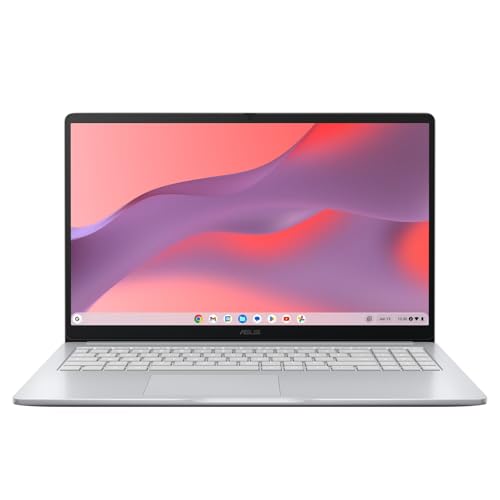
The ASUS Chromebook Plus CX15 takes a straightforward approach to the Chromebook brief: give ChromeOS a large display, generous memory and enough connectivity to function comfortably at a desk. The result is a specification-led productivity laptop whose strengths are easy to identify, provided its fixed storage and non-touch design fit the intended routine.
A practical working canvas
Its 15.6-inch, 1920 x 1080 display should provide ample space for browser tabs, documents and web-based tools, while the anti-glare finish is designed to reduce reflections. This is a non-touch panel, however, so interaction remains keyboard-and-touchpad oriented rather than extending to direct screen control. For buyers who want a traditional laptop interface, that is a clear and uncomplicated arrangement; anyone seeking tablet-style interaction should look elsewhere within the available formats.
The 16GB RAM allocation is one of the machine’s strongest specifications. It gives ChromeOS substantial memory headroom for a busy collection of browser windows and everyday productivity tasks, without relying on an unusually constrained configuration. The Intel Core 3-N355 brings eight cores and eight threads, with a maximum stated speed of 3.9GHz. Those figures establish a capable-looking foundation for general ChromeOS work, although they do not on their own establish results in demanding applications. Intel UHD Graphics handles the visual output, placing the machine within a conventional integrated-graphics design.
Desk-friendly connections
Connectivity is unusually well covered for a simple Chromebook setup. Two USB 3.2 Gen 1 Type-C ports support display and power delivery, joined by a USB 3.2 Gen 1 Type-A port, HDMI 1.4 and a 3.5mm combo audio jack. That combination should accommodate external displays, wired peripherals and headphones without requiring every accessory to use USB-C. Wi-Fi 6 and Bluetooth 5.4 provide current wireless standards on paper, while ChromeOS keeps the software platform clearly defined.
The 50Wh battery is a useful capacity figure, but it should not be treated as a guarantee of endurance: runtime depends on workload and configuration. Storage is more restrictive. The 256GB eMMC drive offers a defined amount of local capacity, but the eMMC format and finite size make this better suited to a predominantly cloud-based workflow than to maintaining a large local library. That is a confirmed design trade-off rather than an incidental detail.
At 1.59kg, the CX15 remains a manageable laptop specification for its 15.6-inch format, though its weight will be noticeable to buyers who prioritise carrying light above screen area. Overall, this is a sensible ChromeOS option for students, home users and desk-based workers who value a spacious Full HD display, abundant RAM and useful physical ports. Its decisive limitations are the absence of touch, finite eMMC storage and a less travel-focused weight profile.