
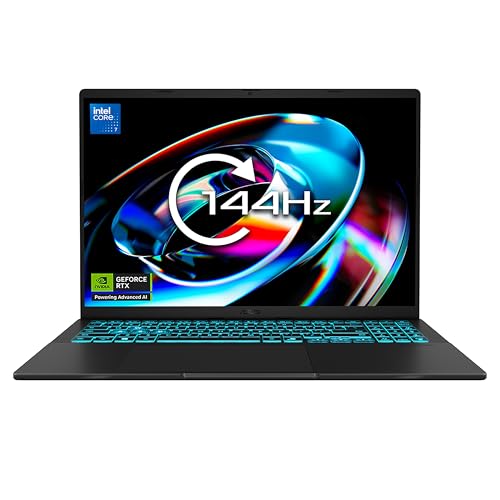
The ASUS V3607 presents a clear proposition: a performance-focused Windows 11 Home laptop that keeps its specification relatively disciplined around a 16-inch chassis. An Intel Core 7 Processor 240H and NVIDIA GeForce RTX 5060 Laptop GPU form the central pairing, with Intel Graphics also listed.
A sensible display brief
The 16-inch IPS panel uses a 1920 x 1200 WUXGA resolution and a 144Hz refresh rate. The refresh rate should provide a sound basis for fluid motion, while the 16:10-style resolution gives the display a little more vertical space than a conventional 1920 x 1080 arrangement. This is a practical screen specification rather than an extravagance: it puts refresh rate and usable workspace ahead of extreme pixel density.
The dedicated RTX 5060 Laptop GPU is the most important differentiator here. It places the V3607 firmly in the discrete-graphics laptop category, whereas the integrated Intel Graphics listing provides a separate graphics option within the stated configuration. The evidence supports a machine designed to handle more graphics-focused work than a basic office notebook, although the supplied facts do not establish real-world frame rates or application performance.
Connectivity with useful range
ASUS has given the V3607 a well-rounded physical interface. Its USB-C port supports display and power delivery, alongside two USB 3.2 Gen 1 Type-A ports, HDMI 2.1 FRL, a 3.5mm combo audio jack and a dedicated DC-in connection. That spread should accommodate external displays, conventional USB accessories and wired audio without relying entirely on adapters. Wi-Fi 6 dual-band wireless and Bluetooth 5.3 extend the same practical approach to compatible network and peripheral connections.
The design is finished in Matte Black, and the 1.95kg weight is notable for a 16-inch performance laptop. It is not weightless: frequent commuters will still have a substantial computer to carry, but the figure keeps the product from becoming an especially cumbersome desktop replacement. The physical trade-off is clearer when considered alongside the 63Wh battery. That is a defined capacity rather than an indication of endurance, and the processor-plus-discrete-GPU configuration makes battery capacity an important part of the buying decision.
The practical verdict
Storage arrives as a 512GB M.2 NVMe PCIe 4.0 SSD, combining a modern interface with a capacity that may become restrictive for a large installed library. The specification identifies the drive format clearly, but does not establish expansion arrangements or practical throughput, so the safer conclusion is simply that initial storage is moderate.