
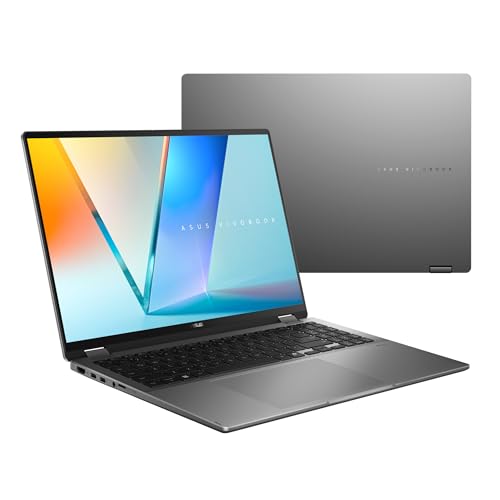
The ASUS Vivobook 14 Flip TP3407 is built around a straightforward proposition: a Windows 11 laptop that gives its display more prominence than a conventional office machine, while retaining a strong set of connections and a sensible hardware foundation. Its 14-inch OLED touchscreen is the defining feature. The 1920 x 1200 WUXGA resolution supplies a practical working format, and the OLED panel should give the machine a more visually distinctive screen specification than a conventional LCD. The 60Hz refresh rate, however, sets a clear ceiling on the panel’s specified motion capability.
Underneath, Intel’s Core Ultra 5 226V processor is paired with 16GB of RAM and a 512GB M.2 NVMe PCIe 4.0 SSD. That combination is well judged for general Windows use on paper: the memory allocation avoids positioning the machine as a basic entry-level system, while the storage technology is modern rather than merely capacious. The 512GB capacity remains a practical compromise. It should accommodate a regular selection of applications and files, but larger local libraries or project collections will use that space more quickly.
Connectivity is one of the Vivobook’s clearest strengths. Thunderbolt 4 sits alongside USB 3.2 Gen 1 Type-A, USB 3.2 Gen 2 Type-C and HDMI 2.1 TMDS, giving the laptop several routes to attach peripherals or an external display. A Micro SD card reader and 3.5mm combo audio jack add useful physical options without requiring every accessory to rely on adapters. Wi-Fi 7 and Bluetooth 5.4 also give the machine current-generation wireless specifications.
The 70Wh battery is a substantial component of the specification, although its capacity alone cannot establish endurance. The 1.57kg weight creates a modest portability trade-off for a 14-inch machine: it remains a compact-sized laptop by screen dimensions, but its mass is an important part of the buying decision for anyone prioritising minimum carry weight. ASUS also identifies the build with the US MIL-STD 810H military-grade standard, which is a stated construction credential rather than proof of any particular real-world durability outcome.
This is therefore best suited to buyers who value a touchscreen OLED display, versatile connectivity and a well-equipped Windows platform over the lightest possible chassis or a faster-than-60Hz panel. The Intel Arc Graphics specification adds an integrated graphics component, while the Core Ultra 5 processor, 16GB memory and PCIe 4.0 SSD create a balanced central platform.
The decisive character of the Vivobook 14 Flip is balance rather than excess. It offers a compelling screen type, contemporary wireless and wired connections, and a solid memory configuration, but its 60Hz refresh rate, 1.57kg weight and 512GB ceiling keep the proposition grounded. For buyers with those priorities, it is a coherent mainstream convertible-laptop choice.