
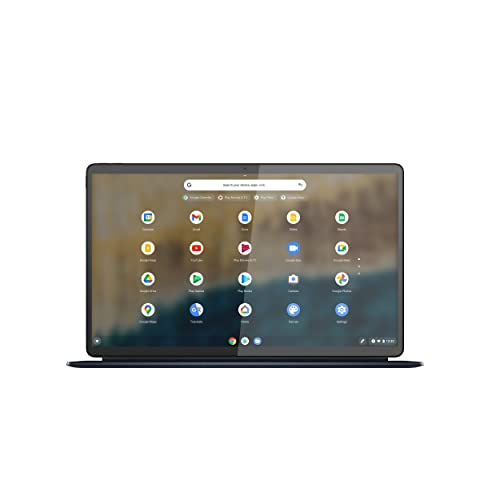
The Lenovo IdeaPad Duet 5 presents a focused Chrome OS proposition: a large 13.3-inch OLED display, a 0.7kg design and a claimed 15-hour battery life. That combination gives it a clear identity as a portable computer for buyers who want a lightweight format without abandoning a relatively generous screen size. The specification is restrained, but coherent.
A screen-led portable design
The display is the headline hardware feature. Its OLED panel runs at 1920 x 1080, giving the machine a Full HD-class resolution alongside the display technology itself. That should provide a technically strong foundation for everyday documents, web pages and video content, although the supplied specification does not establish colour accuracy, brightness or real-world image quality.
Weight is equally important to the product’s positioning. At 0.7kg, the IdeaPad Duet 5 is designed around portability, while Chrome OS gives the software platform a defined, straightforward identity. The claimed 15-hour battery-life figure and 42Wh battery capacity further reinforce its suitability for extended use away from a power socket, subject to the conditions behind that manufacturer claim.
Sensible, but deliberately modest hardware
Processing comes from Qualcomm’s Snapdragon 7c Gen 2, paired with either 4GB or 8GB of RAM and 64GB, 128GB or 256GB of eMMC storage. These choices create a useful spread of configurations, allowing buyers to select a higher memory or storage tier where their requirements justify it. The architecture is clearly positioned towards efficient Chrome OS computing rather than a specification-led performance machine; the supplied facts do not establish application speed, gaming performance or editing capability.
The entry configuration is the main hardware compromise. Four gigabytes of RAM and 64GB of storage are confirmed options, and they leave less capacity and memory headroom than the upper configurations. That does not make the base model unsuitable, but it makes configuration choice particularly relevant for buyers expecting to keep more local content or manage more demanding workloads.
Connectivity and buyer fit
Connectivity is compact: two USB 3.2 Gen 1 Type-C ports sit alongside a pogo-pin connection. This provides a clearly defined set of physical interfaces, but not an expansive port selection. Wireless connectivity comprises Wi-Fi 5, using 802.11ac, and Bluetooth 5.1. Those standards cover the stated wireless specification, while placing the device within an established rather than cutting-edge connectivity tier.