
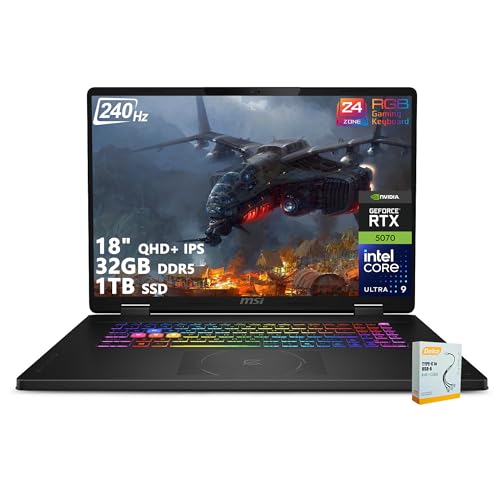
The MSI Crosshair 18 HX AI A2XWX is a large-format performance laptop built around a notably ambitious combination of processor, graphics and display hardware. Its Intel Core Ultra 9 275HX processor and NVIDIA GeForce RTX 5070 Laptop GPU give it a clear technical focus on demanding computing and graphics workloads, while 32GB of RAM and a 2TB NVMe SSD provide a substantial foundation for software, projects and local storage.
A display built for scale and speed
The 18-inch IPS-Level panel runs at 2560x1600 and 240Hz. That combination gives the screen both a detailed resolution and a high refresh-rate foundation, making it particularly coherent for buyers who prioritise a large viewing area alongside fluid motion capability. The format should also offer a more expansive working canvas than smaller laptops, although the physical size is inseparable from the machine’s desktop-replacement character.
The graphics hardware is specified as an RTX 5070 Laptop GPU with 8GB of GDDR7 memory. That is a substantial discrete graphics provision on paper, and it is matched sensibly with the high-refresh display. The specification identifies a machine designed to handle graphics-intensive workloads, though the supplied figures alone do not establish application-specific performance.
Strong capacity, serious connectivity
Memory and storage are among the Crosshair’s clearest practical strengths. Thirty-two gigabytes of RAM should give demanding software a healthy operating foundation, while the 2048GB NVMe SSD offers considerable capacity in a fast storage format. Windows 11 Home is supplied as the operating system, giving the laptop a defined software platform from the outset.
Connectivity is unusually well covered in the supplied specification. The laptop includes three Type-A USB 3.2 Gen 1 ports, Thunderbolt 4 with DisplayPort and Power Delivery 3.0, HDMI 2.1, an RJ45 network connection, Wi-Fi 6E and Bluetooth 5.3. HDMI 2.1 is specified for up to 8K at 60Hz or 4K at 120Hz, while Thunderbolt 4 adds a modern high-bandwidth connection with display support. Together, these ports make the system well suited to a desk with external displays and wired accessories.
The trade-off is physical scale
The central compromise is straightforward: this is a 3.1kg laptop with an 18-inch screen. That weight makes regular carrying less practical, and the large display creates a substantial footprint in bags and on desks. The 90Wh battery is sizeable by specification, but capacity alone does not establish endurance.