
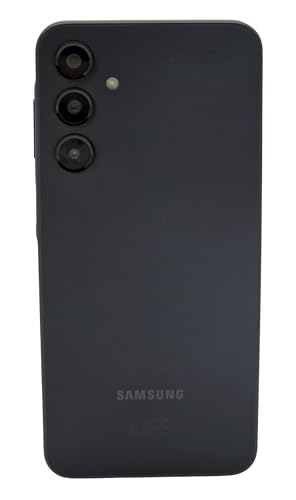
The Samsung Galaxy A16 4G presents a straightforward mainstream smartphone proposition: a large Super AMOLED screen, substantial battery capacity and a three-camera rear system, wrapped around an octa-core platform. It is a specification-led device for buyers who value the fundamentals of display, storage and power provision, while its 4GB RAM and 200g weight make the overall balance more clearly defined.
A display-led proposition
The 6.7-inch panel is the phone’s most obvious structural feature. Its 1080 x 2340 resolution gives the screen a detailed technical foundation, while Super AMOLED technology and a 90Hz refresh rate support a more capable presentation on paper than a basic low-refresh display. Those figures make the A16 4G particularly suited to buyers who want a generous viewing area for general phone use, reading and media.
The size also determines the handset’s physical character. At 200g, it is not a lightweight design, and that mass is a confirmed trade-off for anyone seeking a less substantial phone. Its 7.9mm thickness keeps the body specification relatively measured, but the weight remains an important part of the buying decision.
Core hardware and endurance provision
An octa-core CPU reaching 2.2GHz provides the central processing architecture, with the specification pairing 2.2GHz and 2.0GHz frequencies across its cores. That establishes a conventional multi-core foundation for the device, without supporting claims about application speed or gaming performance. The 4GB RAM configuration is clearly set, and buyers who keep many tasks open should regard that capacity as part of the phone’s defined hardware profile rather than an expandable promise.
The 5000mAh battery is one of the A16 4G’s strongest numerical provisions. It gives the handset substantial energy capacity on paper, while 25W charging sets the stated wired charging rate. Wireless charging is not included, so the charging arrangement is firmly conventional rather than cable-free.
Cameras and practical protection
The rear camera specification combines 50MP, 5MP and 2MP sensors, with apertures of f/1.8, f/2.2 and f/2.4. That gives the phone a three-sensor imaging arrangement, led by a higher-resolution main camera. The 13MP front camera supplies a separate selfie-camera specification. However, optical image stabilisation is absent, which is a confirmed limitation in the camera hardware rather than a judgement about resulting photographs.