
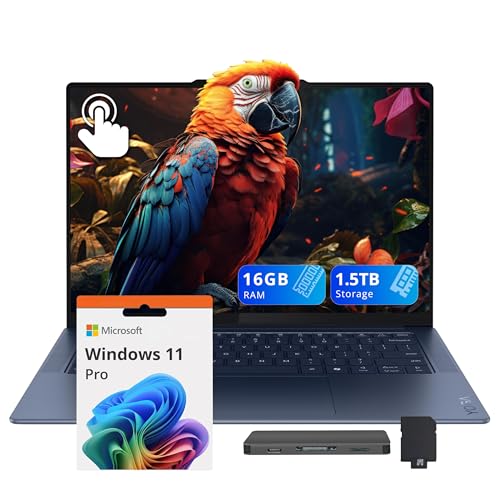
The Lenovo Yoga Slim 7 14AKP10 is a compact 14-inch laptop built around a clear set of priorities: low weight, an OLED display, contemporary connectivity and an AMD Ryzen AI 7 350 processor. At 1.19kg, with aluminium on both the top and bottom, it has the specification profile of a machine intended to move regularly between desks, bags and meeting rooms.
Focused display specification
The 14-inch OLED panel is the most distinctive part of the visual specification. Its 1920x1200 resolution provides a 16:10 workspace, while OLED technology gives the screen a technically advanced foundation for general productivity and media use. The limitation is equally clear: the 60Hz refresh rate fixes the panel’s update ceiling at a conventional level rather than a high-refresh one. That is not inherently a problem for office work, but it defines the display’s priorities.
The AMD Ryzen AI 7 350 processor is paired with 16GB of RAM and integrated AMD Radeon 860M graphics. This is a coherent single-platform arrangement for buyers seeking a thin, relatively light computer rather than a machine defined by separate graphics hardware. The integrated design is also a confirmed trade-off: the Radeon 860M forms part of the laptop’s shared platform, rather than representing a separate graphics component. No stronger conclusion about application or game performance follows from these specifications alone.
Useful connections in a compact frame
Connectivity is unusually well covered on paper for a lightweight 14-inch model. Two USB-C ports support USB4 at up to 40Gbps, USB Power Delivery at 45–65W and DisplayPort 2.1. Alongside them sit a USB-A port with USB 5Gbps, an HDMI 2.1 output supporting up to 4K at 60Hz, and a 3.5mm headphone/microphone combo jack. That combination should accommodate modern USB-C accessories while retaining familiar peripheral and display connections.
Wireless connectivity is similarly current, with Wi-Fi 7 specified as 802.11be 2x2 and Bluetooth 5.4. These standards give the laptop a modern communications foundation, although the practical result will depend on compatible networks and devices. The 70Wh battery is a substantial stated component of the design, but capacity alone does not establish endurance.
Storage comes as a 512GB NVMe SSD. That supplies solid-state local storage in a defined capacity, while also placing a clear limit on how much software and media can remain on the laptop without additional storage arrangements. The 16GB memory allocation gives the platform a stated multitasking baseline, but this review does not infer performance outcomes from capacity alone.